
☰
NSF Center for
Digital Twins in Manufacturing
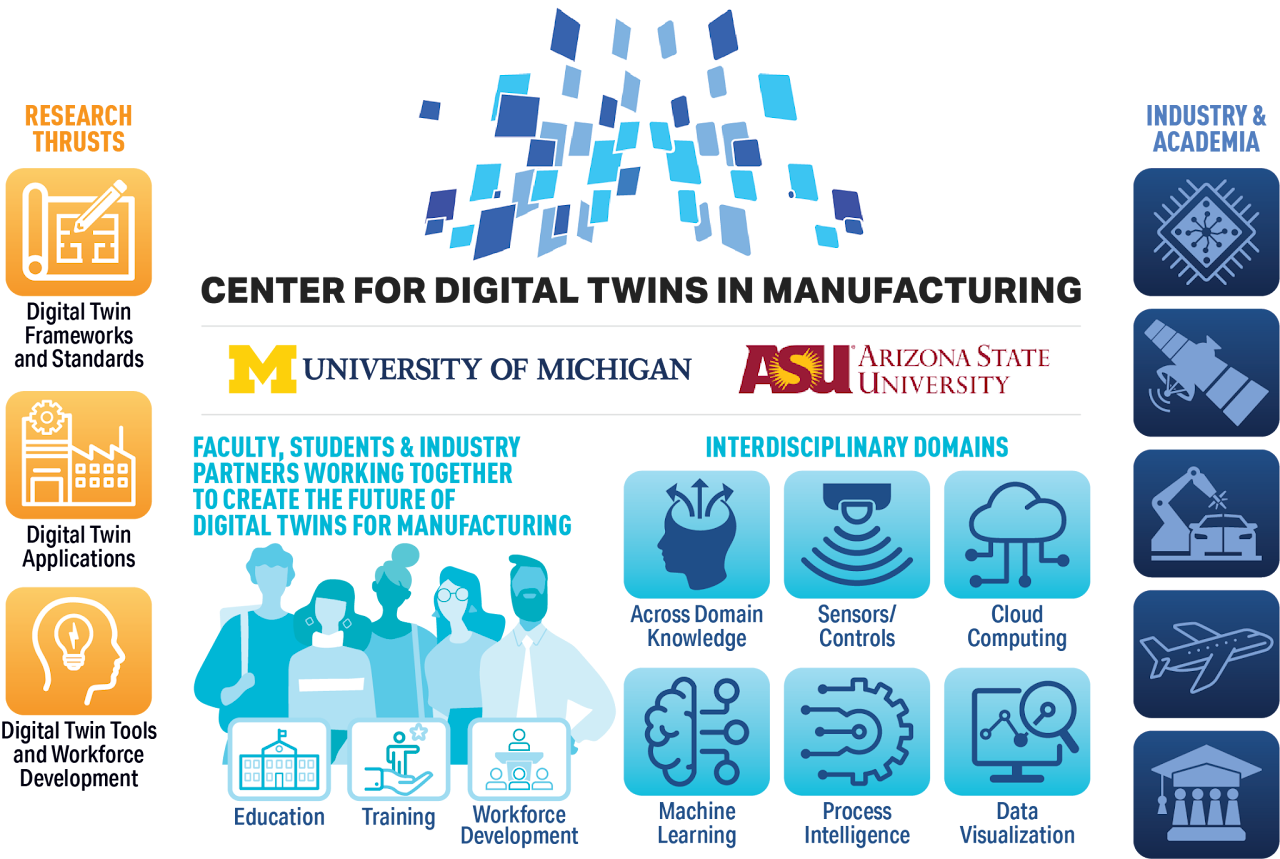
A collaboration between the University of Michigan and Arizona State University, focused on developing digital twin solutions for manufacturing.
Center Mission: Provide pre-competitive research outcomes for our manufacturing IAB membership (and the manufacturing industry in general) that increase member productivity and ROI through the advancement of digital twin technology and solutions across the manufacturing ecosystem.
Latest Updates
Center IAB Meeting
Receive research and project updates
Join the Industry Advisory Board to shape the future of digital twin research.
Express your interestCenter Timeline
Research Thrusts
Three interconnected research areas driving digital twin innovation in manufacturing.
Digital Twin Frameworks and Standards
Creating standardized, interoperable digital twin frameworks that can be adopted across diverse manufacturing environments and industries, moving beyond siloed solutions.
Digital Twin Applications
Developing practical applications of digital twin technology across various manufacturing sectors including automotive, aerospace, and other industrial domains.
Digital Twin Tools and Workforce Development
Creating advanced tools for digital twin implementation while training the next generation of engineers and researchers in digital twin technologies.
Industry Benefits
The potential benefits of the Center research are significant and expansive. Improvements in re-usability, extensibility, interoperability and maintainability of solutions will improve manufacturing throughput and quality and reduce cost directly. Key DT framework capabilities such as virtual commissioning will facilitate faster and lower-cost ramp-up.
A common framework will allow the benefits to extend to the entire manufacturing ecosystem and will enhance capabilities such as security and customer responsiveness. Lastly the Center will promote workforce development and empowerment by establishing environments and solutions for training, benchmarking and collaboration between competitors, suppliers, and customers in a technical, pre-competitive forum.
Member Benefits
- Increased productivity and competitive advantage
- Improved KPIs — higher revenue, reduced costs
- Influence the direction of technology development
- Pre-competitive collaboration with customers, suppliers, and competitors
- Cross-sector connections and shared learnings
- Recruit talent trained on cutting-edge research
- Employee skill development through joint research projects
Greater Context
Digital Twins (DTs) have become pervasive in the manufacturing industry. Here we adopt the DT definition of [Moyne et al.], that a digital twin is some level of purpose-driven replica of a real thing (the physical twin) and is synchronized with its physical twin (equipment, component, process, product, etc.). Leveraging historical and real-time data, as well as data-driven and first-principles models, DTs in disparate forms have been used to solve manufacturing problems such as predictive maintenance and model-based process control.
Potential
They have the potential to increase productivity and reduce costs, by reducing unscheduled downtime, increasing yield (reducing scrap), optimizing the supply-chain manufacturing ecosystem, and even facilitating reconfiguration of assets for rapid, low-cost virtual commissioning.
Past Approach
DT solutions have typically been developed in silos, which creates a strain on workforce, solution upkeep and maintenance, security, sustainability.
Current Effort
A common DT framework and approach has the potential to significantly reduce demands on workforce expertise, improve productivity through cross-training and re-use of existing solutions, streamline maintenance, and improve security and sustainability. The NSF-funded Center for Digital Twins will bring together a group of industry partners and academics for collaborative research to develop DTs across a common framework to help improve manufacturing solutions.
What is an IUCRC?
A National Science Foundation (NSF) Industry-University Cooperative Research Center (IUCRC) is developed around emerging research topics of current research interest, in a pre-competitive space but with clear pathways to applied research and commercial development. NSF supports the administration and operation of IUCRCs. Industry partners support the research projects through their membership dues and choose the specific research projects that the center will execute.
Learn more about the IUCRC program (opens in new tab)